Where's Walnut?
Seasoned foragers all have a list. It's the things we’re quietly obsessed with finding, but haven't managed to track down yet. Black walnuts have been on the top of my list for a while.

We research it. We beg other foragers to spill their secret spots. We slam on the brakes if we think we’ve spotted it from the car.

For many foragers, their bucket list items are so notoriously scarce they go to extreme measures! One of my foraging friends even went so far as to dig through 1960s parish maps, which are old government land records showing where European migrants had settled.
Their logic? Post-WWII migrants faced far fewer restrictions on importing plants than we do now. Trees were brought over from Europe (along with hitchhiking mushroom spores and mycelium). That’s actually why older settlement towns sometimes host rare European fungi.

I didn't go through such extreme measures to find walnuts. But I have trawled through old iNaturalist sightings, sent friends out with detailed instructions on what to look for, and stayed permanently alert. In the end I got lucky during a picnic, noticing a tree on the edges of a park I'd visited before.

The nuts alone aren’t all that exciting. Everyone is familiar with regular old supermarket walnuts. But unripe green walnuts? That's something magic! The unripe nuts can be harvested in a short window between late December and early January.

There are several types of walnut trees, but the two most common are black walnuts (Juglans nigra) and the English walnut (Juglans regia). They taste quite different, but both can be used in recipes. Black walnuts are powerfully earthy and sharp with a bitter edge. Don't let the name confuse you, black walnuts are still green coloured while unripe. English walnuts are sweeter and taste more herbal.

When cooking with green walnuts, you use the whole fruit; the nut as well as its soft outer husk. They’re intensely tannic and acrid, so they need extra time and preparations to tame them. But the payoff is something extra special!

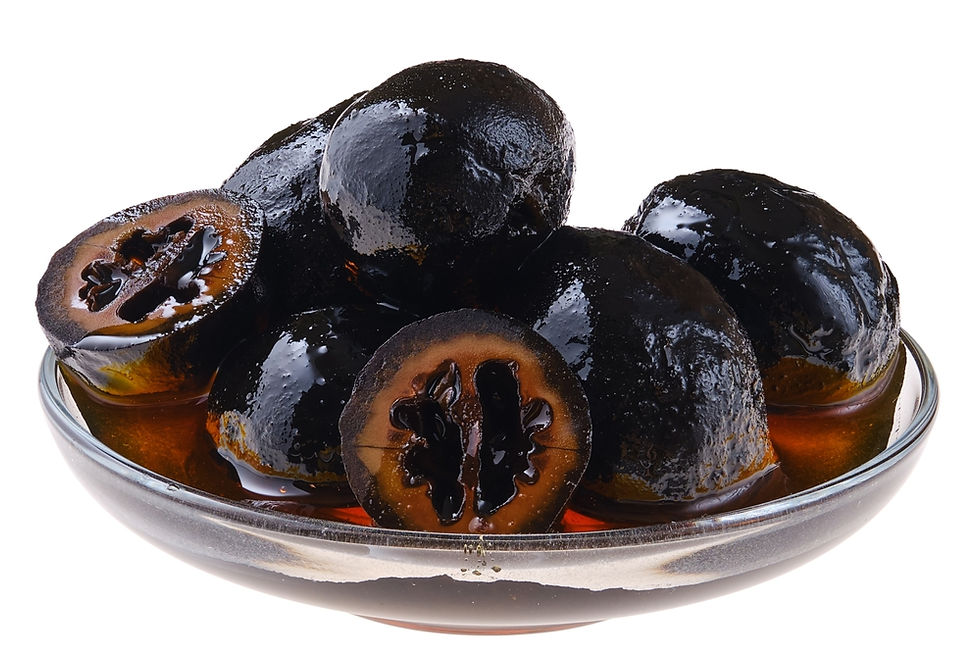
Green walnut jam is something I've wanted to make for a long time. You peel away the thin outer layer of the husk, pierce the husks, soak them with daily water changes for at least a week, then slowly cook them in sugar syrup with vanilla, before leaving the jam to mature for a month or two. It sounds like an absurd amount of effort, but the result is a pitch-black and intensely flavoured jam, tasting like super concentrated caramelised walnut. Pair it with cheese or charcuterie, or use in desserts.

I’m in the middle of making this now, my walnuts are soaking as we speak. You’re meant to wear gloves while prepping them, but in my excitement I completely ignored that advice. A few days later, my hands are still stained dark brown. Black walnuts stain harder than permanent marker, so learn from my mistake and put on a pair of disposable gloves if you try this.
Green walnut liqueurs are a bit of a secret handshake among foragers. Nocino is a digestif made by steeping halved unripe walnuts in vodka with vanilla, cinnamon, and cloves. A friend makes a cheat version using spiced rum. Vin de Noix is another classic, which is a rich walnut wine made by macerating green walnuts in red wine, brandy, and honey.

There are lots of other fun things you can do with them. Green walnut honey, molasses, a mugolio style syrup, ketchup, even pickles (they taste surprisingly similar to olives).

Green walnuts also have a long history as medicine, as the outer husk is strongly antifungal and antimicrobial. It's been traditionally used for embarrassing ailments like jock itch, thrush, and intestinal worms. The husk does not mess around.

So, what are we actually looking for? How do you identify a walnut tree?

Leaves
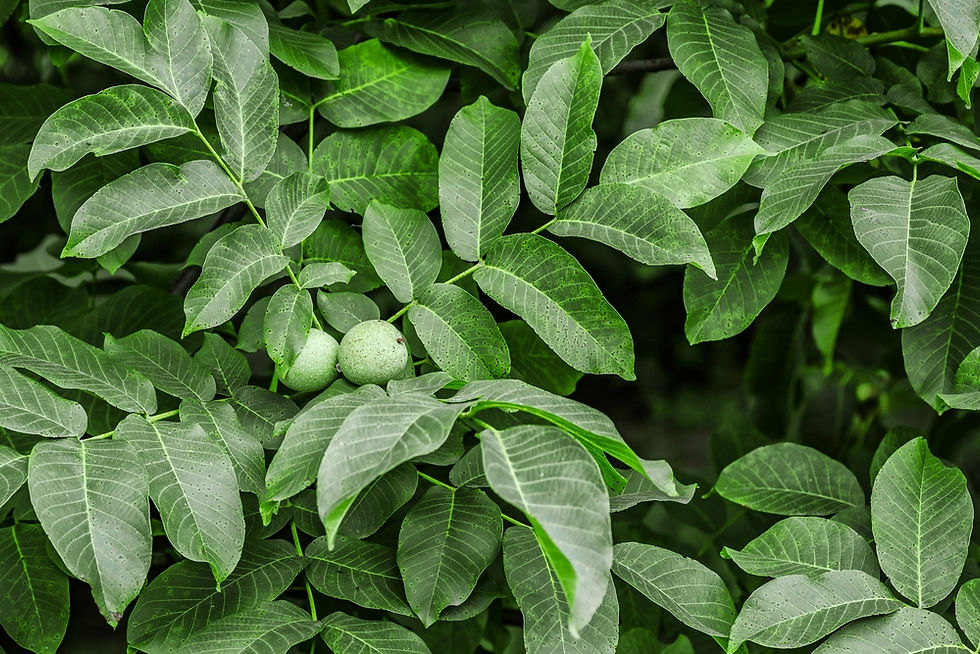
• Arrangement: Each leaf is made up of multiple leaflets (compound leaf), growing in opposite pairs.
• Black walnut: Typically 15–22 narrow leaflets, with serrated edges.
• English walnut: 5–9 broad, oval leaflets, with mostly smooth edges. A terminal leaflet is a single leaflet at the tip of the compound leaf
• Black walnut: Might not have a terminal leaflet, or will have a smaller one.
• English walnut: Has a larger terminal leaflet.

Nuts
• Black walnuts: Almost perfectly spherical once ripe. Husks are thick and rugged, with pale speckles, and turn black as they mature. They stain hands a deep brown that lingers for weeks.
• English walnuts: Oval or slightly elongated. Husks are smoother, also speckled, and split open easily when ripe. Their staining is mild and usually washes off.

Scent
• Black walnut: Aggressive and distinct; like lime peel, pine resin and cleaning chemicals. • English walnut: Warm, sweet, and nutty; a delightfully intoxicating purfume.
Tree
• Black walnut: A large tree, often 20–30 metres tall. Typically has a straight trunk and a high, spreading crown when grown in the open.
• English walnut: A smaller, broad-crowned tree, usually 10–20 metres tall. Often has a shorter, thick trunk and a wide, rounded canopy.

Bark
• Black walnut: Very dark brown, deeply furrowed with narrow, rough ridges.
• English walnut: Light ash-grey, smoother, developing diamond-shaped ridges with age.

Flowers (spring)
• Male Flowers (Catkins): Produce long, drooping, yellow-green catkins.
Black walnut: Catkins are often slightly longer
• Female Flowers: Tiny clusters at the tips of new shoots.
English walnuts typically produce more female flower clusters (3-9) per shoot than black walnut (1-3).

There’s a lot of lore wrapped up in how walnuts were harvested. Traditionally, green walnuts were picked barefoot, partly so you could feel fallen nuts underfoot to avoid spraining your ankles.

Some traditions also insisted they only be gathered by young women. How sexist! Oh well, more for me and less for the men!

Timing matters more than anything with green walnuts. The harvest window is short and unforgiving, especially if you’re making jam or pickles. You’re aiming for husks around ping pong ball size, when the inner shell is still soft enough to slice cleanly and is white inside. Too small and they’re underdeveloped; too old and the shell starts to harden. There is a little flexibility if you’re making liqueurs — slightly younger or slightly older nuts can still work, but only by a narrow margin.

That’s part of what makes green walnuts so special. You can’t rush them, you can’t substitute them, you can't mistime their harvest or buy them at the shops. And that’s why they’re worth adding to your foraging list.


Comments