Grey Knight in Shining Armour
Updated: Jul 5
Grey Knights, Tricholoma terreum, are an abundant little mushie. You'll find them peppered along pine forest paths, guiding the way with a winding silver trail. They're common, delicious, and underappreciated.

They have a bit of a confusing and complicated relationship with foragers. They're the on-again, off-again wild romance of mushrooms. But messy love stories are sometimes the best.

But before I fill you in on the drama, what are we looking for?

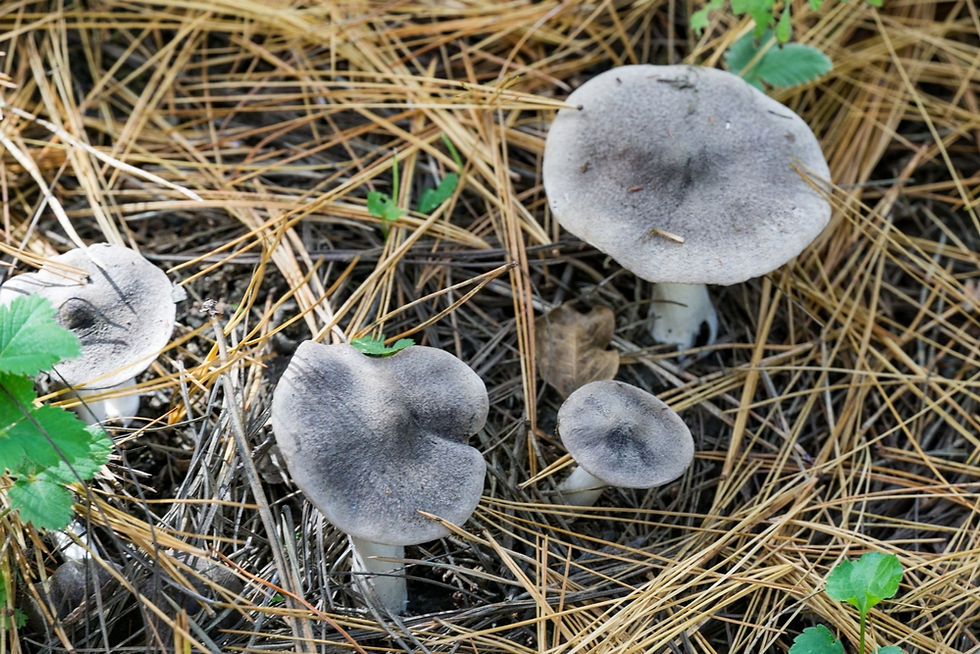
Cap: • Grey • Felt-like texture • Sometimes a white line around the rim • Uniform coloured; not patchy, patterned or spotty • Can sound squeaky when sliced • Usually pretty uniform in size, about 6 cm

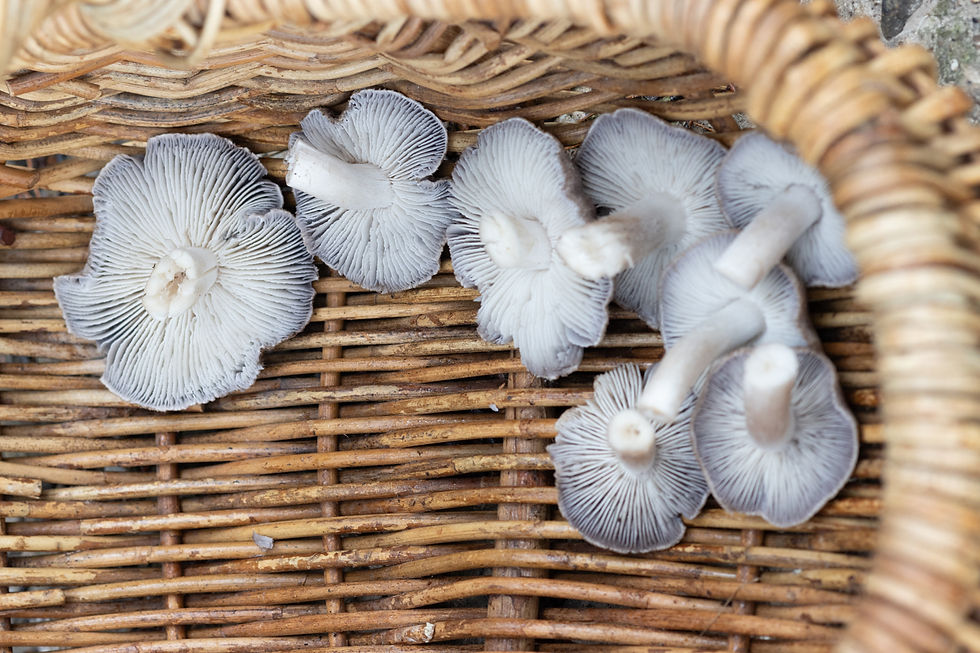
Underside: • White gills, darkens to pale grey with age • Moderately spaced gills • White spores • Gills attach to the stem with a small, sharp notch [emarginate]

Stipe (stem):
• White
• Splits like string cheese when pinched
• Carefully check to make sure there's no ring/annulus or veil remnants
• No flare, the stem is consistently the same width
• Thin hollow section when cut in half
• Fragile
Smell:
• Some people describe them smelling faintly of gin or hazelnuts
• Mild or no discernable smell

Season:
• Most abundant May – July

Location: • Ballarat, Dandenongs, Daylesford, Emerald, King Lake, Macedon, Neerim, all your typical foraging spots • Grows with several types of conifers, but to reduce the chances of picking a lookalike, you might prefer to pick only with Radiata pine trees

A lot of people think Grey Knights are risky. And yeah... sorta, kinda, maybe? But not for the reasons you keep hearing. This year in mushroom ID groups, I’ve seen a couple of rookies mistake a Marbled Death Cap, Amanita marmorata, for a Grey Knight, then realise their mistake and quickly delete their incorrect ID. That’s the worst possible mushroom you could confuse with a Grey Knight.

Marbled Death Caps are a temperamental little mushie. Sometimes they contain deadly amatoxins, and sometimes not. Some samples only contain phallotoxins, which won’t kill you, but will make you poop your pants.

The reason for the variation is that Amanita marmorata is probably a species complex rather than one single species. But you should treat every Marbled Death Cap as potentially lethal, and never confuse one with a Grey Knight.

While foragers with a bit of experience can easily spot the difference, inexperienced pickers can get confused because a few features overlap. White stem, white gills, grey-ish cap. They can both grow with Radiata pine trees. For all mushrooms, look at every feature, so nothing suss ends up in your basket.

Marbled Death Caps have a bulb at the base of the stem, a sac-like structure called a volva. This volva can sometimes be hidden beneath leaf litter, so it’s worth double checking. The cap is smooth instead of felted, and is often a marbled brown-grey colour when young, becoming paler with age. There’s also a ring on the upper stem called an annulus, but don’t rely on that feature alone because it can easily rub off. The annulus is thinner than tissue paper and more fragile than the ring found on many other Amanitas.
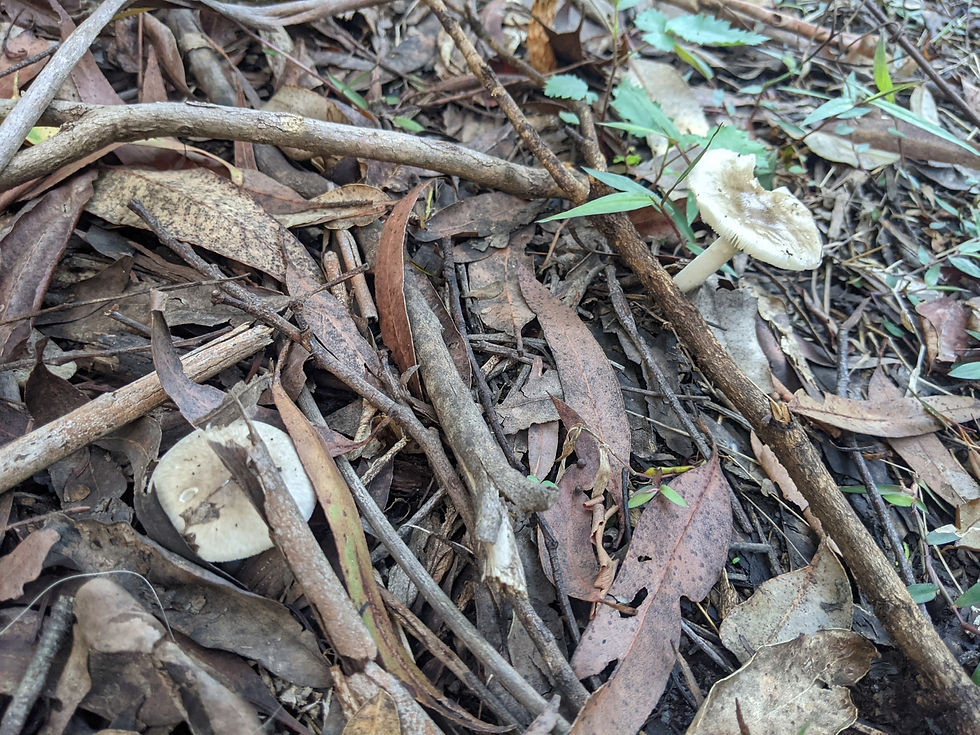
There's plenty of other lookalikes to be aware of though. Some lookalikes are so indistinguishable, they've caused a cascade of misinformation about Grey Knights to spread through the foraging world.
Back in 2014, a team of chemists were conducting a toxicity study on Grey Knights. They messed up by not having an expert mushroom identifier in their research team. When attempting to collect a wild sample of Grey Knight mushrooms, they probably confused them with another similar looking Tricholoma species. The test results were toxic.
Since that study, they've been retested several times, and no one’s ever been able to replicate those toxicity results. The mycology overlords agree: Grey Knights are a safe, edible mushroom.

The initial warning still pops up in foraging groups from time to time. Fungal fearmongering spreads fast. But rest assured, there's no evidence to suggest you need to limit the amount of Grey Knights you eat.
The silver lining of the flawed study is that it shows how easily they can be confused with naughty lookalikes!

While mushroom foraging is generally safe (provided you've done your research!), it will never be completely risk free, because humans are human. We're an overconfident bunch who make mistakes. But we can tilt the odds in our favour by becoming a total mushroom nerd. Learn to identify every part of the mushroom: the gills, the cap, the stipe, the annulus, everything! Smell it, feel it, check the environment, because every little feature means something.

The lookalike species most likely to trip people up are in the Tricholoma genus, the same group as Grey Knights. In the northern hemisphere, there are some especially dubious doppelgängers.
The Spotted Tricholoma, Tricholoma pardinum, and the Ashen Knight, Tricholoma virgatum, are toxic and will choose violence. These two mushrooms can cause muscle breakdown which results in kidney failure. In documented cases of this kind of poisoning, people were eating roughly 100–300g servings repeatedly over multiple meals. But there’s no established safe dose quantity as people have varying levels of susceptibility.

It's speculated whether they could exist in Australia, but there's been no confirmed sightings... at least not yet.
The Spotted Tricholoma has a cap that is a bit more scaly or spotted, and is a little larger.

The Ashen Knight has a cap that is more pointed and a little browner, but not always. Sometimes it looks just like a Grey Knight, and you can't tell the difference by looking at them alone.

In Australia, the chance you'll ever see an Ashen or Spotted Knight is slim to none, but it's not completely impossible. There's no harm being aware of how to exclude toxic lookalikes, even if it'a one in a million shot.
A way to distinguish these potentially identical looklikes is by their smell and taste:
Grey Knight (edible) | Smell: Mild, faint note of gin. Taste: Subtle mushroom taste. |
Ashen Knight (toxic) | Smell: Unpleasant. Musty, radish, peppery, old flour, cucumber. Occasionally mild. Taste: Bitter, peppery, acrid, sharp. |
Spotted Tricholoma (toxic) | Smell: Mild flour or cucumber Taste: Flour, sometimes a slight bitterness |

The nose knows! Stick your nose in every mushroom you can find, and get familiar with their scents. There are so many distinct mushie smells, ranging everywhere from lavender, bleach, apricot, liquorice, marzipan, cucumber, or my least favourite... spermatic. Yeah that's exactly what you're thinking, and it's gross. Anyway, it's good practice to have a smell of every mushie you find, even if it's a hit of stinky jizz. The distinct smell of some mushrooms is a piece of the puzzle that helps you separate them from their lookalikes. An example is Wood Blewits (delightful orange juice concentrate scent) vs Emperor Cortinarius (dusty grandpa stench). If you can't smell anything, try breaking or rubbing the mushroom, like an oldskool Scratch n' Sniff.

The next thing to try is tasting the mushroom. Spit, don't swallow! You shouldn't swallow any old thing that ends up in your mouth. You can do a 'spit test'. Bite a small amount of the mushroom, chew, taste, and then spit it out. Make a stupid hawk tuah joke if you must. Come prepared with a tissue and a sip of water to rinse afterwards if you're a princess like me. All mushrooms, even toxic mushrooms like Death Caps, can be tasted and spat out. You need to ingest them to absorb any toxins.
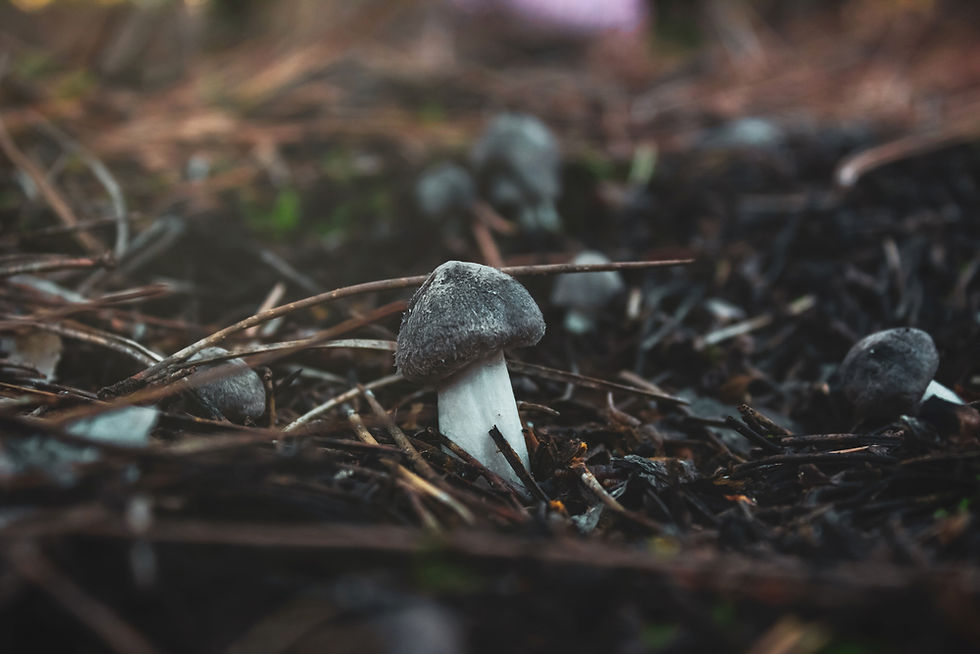
But to make matters more confusing, one of Australia's most knowledgeable mycologists, Bruce Fuhrer, included the Ashen Knight in his book, Field Guide to Australian Fungi (2005) and this photo really does look identical to a Grey Knight! But it's likely he was also mistaken.
So how could a pro get it wrong?
It's because Australian fungi taxonomy has been a complete dumpster fire. For decades, species were identified from vague descriptions, compared to dried (instead of fresh) herbarium specimens, lumped in with similar looking overseas species, or guessed based off a mycologist's childlike doodles in their notebooks.

Some Australian species were described so poorly that modern mycologists still can’t figure out what they're meant to be. Before DNA sequencing became common, some educated guesses were made. We didn't have colour textbooks with photos to compare against. Bruce Fuhrer was working with the best available science of his time, and made a reasonable assumption from inferior data.
Even though it's unlikely Ashen or Spotted Knights exist in Australia, you don't wanna be the first sucker to poison yourself with them. There's no harm doing a little smell and taste test to rule these two out.

When eating wild mushrooms, you need to accept some level of risk. It's marginal if you know what you're doing, but still there. But nothing in life is without risk! If you're concerned, you can further mitigate risk by:
• Eating a smaller amount • Picking from the same patches frequented by other foragers, and sticking to the same patches you've eaten from before • Consider keeping a few mushrooms in the fridge, kept aside for emergency testing • Picking only around Radiata Pine trees
• Posting a photo of your mushroom haul in a mushroom ID group to get a second opinion. Do this with any new mushroom you're picking. The identification pros like to help, so don't be shy!

This might all seem scary, and a mushroom meal isn't worth any anxiety that follows. If you're worried about them, do a bit of extra research and trawl through articles on the internet and in mushroom ID groups. Study up to build your confidence, and don't eat anything until you are.

Many foragers, including myself, enjoy them. Grey Knights are even sold at VIC Markets, sold among other more common wild mushrooms like Slipperies and Saffies.
Grey Knights are mild tasting, slightly sweet with no bitterness, and have a fantastic slightly chewy texture. They are easy to incorporate in so many different recipes.

They're great in stir fries, soups, tacos, curries, sandwiches, omelettes, or preserved in oil and vinegar. Make them into a side dish with some parsley and garlic. I love them cooked with ramen. Because they're chewy, they can be stewed or slow cooked. They don't need especially long cooking time like some other wild mushrooms, but do make sure they're cooked for at least a few minutes to reduce the chance of having any sensitivity.
They pop up in late autumn and winter, so if you're lucky, pair them earlier in the season with some foraged hazelnuts or chestnuts (surprisingly easy to forage in Victoria), or later in the season with some Onion Weed, Allium triquetrum.
Foragers have been eating Grey Knights for generations, and despite all the drama, they remain one of the most abundant and underrated wild mushrooms in Victoria.
They're a great mushroom to consider adding to your repertoire because they're yummy and abundant. They’re for adventurous foragers, who’ve done their research and are ready to add a new mushie to their list.
So when you're out wandering through a pine forest this winter, keep an eye out for Grey Knights. Once you spot one, you'll find a whole little gathering nearby. They pop up in clusters, as though they're having a little woodland tea party. You'll gather enough to make a beautiful pot of soup. Few things feel more like winter than a bowl of soup made from mushrooms you foraged yourself. Coming inside from the cold forest, wiping the mud off your boots, you transition from forest adventurer to humble home cook. Soon the kitchen fills with warmth as a pot of Grey Knight soup bubbles away on the stove. The house smells wonderful, and the people you love gather around the table, thankful for the mushroom feast. Life is good, bon appétit.


Comments