The Holy Grail: Porcini
Updated: Aug 19
Mushrooming is usually a treasure hunt in the forest. You wander through the wilderness, taking in every detail, until you uncover a whole bounty of mushrooms hiding beneath leaf litter. Ah, the excitement of a haul! A basket overflowing with abundance, enough to host the most glorious dinner party.

But foraging for Porcini isn't like this. They're so elusive in Victoria, there's a one in a million shot you'll stumble upon one. Expect a sad, empty basket. The lucky few who have found them will send everyone else on a wild goose chase.
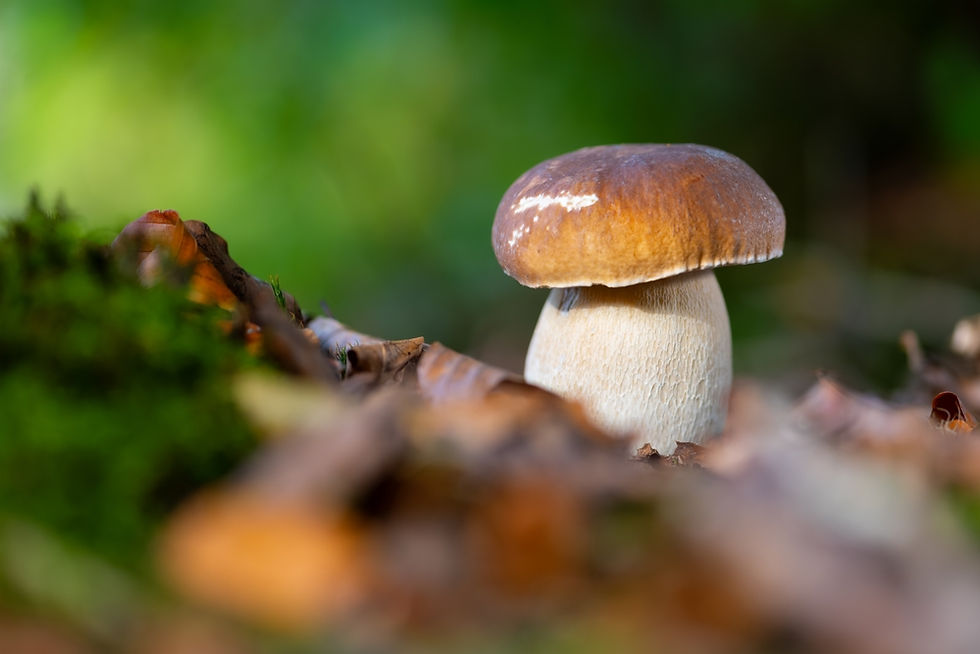
But the forest tells a prophecy of its hidden mushroom king, so join me on the Porcini pilgrimage.

So what does Porcini (Boletus edulis¹) look like? Boletus means lump, edulis means edible, so the binomial name basically means 'lumpy food'. Checks out.
Stem (stipe):
• The key identifier is the honeycomb reticulation (raised mesh texture/ snake skin pattern), typically on the upper third of the stipe
• Chonky, bulbous • Cream coloured with brown flecks

Cap Underside (hymenium):
• Pores instead of gills, small and round
• Pores start off white, ages to yellow, then olive brown when old
• No staining (does not change colour when bruised)

Cap:
• Light brown to dark chestnut, sometimes with a whitish bloom when young
• Smooth initially, velvety with age, can be greasy in wet weather
• 5cm-30cm in diameter
• Often has a white rim or white line at the margin

Smell:
• Basic mushroom smell, nothing special

Associated trees: • Many types, but typically found with Oak, Conifers and Chestnut around Melbourne

Lookalikes:
• Compare against potentially toxic native boletes, and newbie foragers might confuse them with Suillus species.
They're not too difficult to ID, but they're difficult to find.

One friend went so far as lighting church candles and saying a prayer for Porcini. There's a stage in the hunt when you resort to all levels of desperation. God must get a spike in fungi related petitions each season.

Some foragers approach Porcini like a criminal cold case, where you investigate fragile leads, each clue leading you deeper down the rabbit hole. Tracking them down is its own kind of fun, as you play detective.

There are a few key things to investigate that will help you along your way. Any successful hunt usually comes down to these clues, but for Porcini you need to dive deep:
• Having an idea of the rough locations
• Knowing which trees to look under
• Foraging during the best weather conditions

LOCATIONS:
Start with the right areas. If you're devoted enough for an overnight road trip, they're found in relative abundance in the Adelaide Hills.

But if you have a stroke of luck, you could find them closer to home. Porcini have even been foraged in a park not too far from Melbourne's CBD, as well as in Melbourne's eastern suburbs.
Out of respect for those who guard these secret spots, I can only point you in a vague direction. Forager’s code, you know.
Your best local starting point is probably the Dandenong Ranges; there are about 10 different patches around there. They are also known to grow in the Alpine Shire, Central Highlands, Central Victoria, the Green Triangle, Mornington Peninsula, the Otways, and Victorian High Country.

I offer these clues as enough to start the journey, but the discovery is your own.
Some are in timber plantations, others in the middle of nature, and several on private property like farms, homes and businesses.

Fence lines test my character during foraging season, but don't jump a fence if you spot a Porcini! Stealing a Porcini is grand larceny and you'll be busted custard if you're caught. If you happen to see one on someone's property, you could try knocking on the door, then lay on the charm (or beg), but expect to be turned away.
When it comes to knowing where to look, there's a bit of research you can do to narrow down the hunt.

iNaturalist is an app where people upload photos of plants, fungi, and pretty much anything in nature. You can browse the map to see what's been spotted in your area, and helps you scout out what's around before you leave home.
Very few will share their Porcini finds, no forager wants to give away their secret spot. But there is a legitimate Victorian sighting on there! To throw you off the scent, people have posted fake Porcini sightings as well, along with pins that are 'obscured,' hiding the exact spot within a huge area. Figuring out the real sightings from the fake is part of the challenge.

But you can actually use those decoy sightings to your advantage with this little trick: Check the profile of someone who posted a suspicious Porcini. Look for other mushrooms they’ve observed around the same date. If they posted a different species in another area on the same day, there’s a good chance they were actually foraging there, and the Porcini patch could be nearby. You can also spot trends by seeing which regions a forager visits repeatedly. Over time, patterns emerge that hint at their real hunting grounds.

Another trick is to go full detective mode by checking old government settlement records through Parish Maps. Porcini were an accidental import into Australia, their mycelium stowed away within the soil and root systems of European trees. This happened in the 1950s-1970s, thanks to post-WWII migrants, at a time when biosecurity controls on plant imports were lenient. Because most Victorian Porcini arrived with European migrants, some people try targeting areas where these migrants settled, by checking towns known for Italian or Greek migration.
One of my friends used this method and finally got lucky. He even bumped into the neighbour who probably was the one who unknowingly imported the fungi.
TREES:
Once you've determined what suburbs to suss out, your next task is to decode the landscape itself. Porcini don’t just grow anywhere, they exist only in partnership with specific types of trees.
In Victoria, most Porcini patches are linked with Radiata Pines, Oaks and Chestnut, so learn to identify these first. They’ve also been found in VIC with Beech, Birch, Douglas fir, Fir, Hazelnuts, Pines, Spruce. There are whispers that it's been found once with Hemlock. Elsewhere in the world, Porcini grow with Arbutus, Cistus, Halimium, Hornbeam, Keteleeria, Linden, Poplar, Willow, and potentially Larch, but none of these associations have been recorded in Australia.

Why only these specific trees? Because certain tree roots and mycelium recognise each other through unique chemical signals. Before they even touch, they exchange a complex molecular dialogue, activating genes that prepare them for a mycorrhizal relationship.

In layman's terms, they make a little underground friendship. The tree swaps sugars for the fungi's water and nutrients. Many trees struggle without fungi helping them, and Porcini can’t survive without the right tree.

Another tip that will stack your odds is targeting spots where multiple types of host trees grow together. Patches with both Oak and Pine, for instance, seem to create more resilient underground networks. The fungi have wider access to sugars from different trees, which may help the mycelium thrive and produce more mushrooms. So, when you're scouting locations, keep your eyes peeled for varied partner trees.

Nearly all Victorian Porcini are growing alongside mature trees, many of which have been around since early European settlement. That said, there’s a small chance you might find them around younger trees, especially if someone has successfully inoculated the area.

So, how do you track down the right trees? Here are a few approaches worth trying:
• Always be on the lookout! Every time you go for a long drive, notice what tree types you're driving past. Learn to ID trees. A good starting point for tree identification is looking at leaf shapes, and whether they have cones or nuts. • Try the iNaturalist app to identify and locate tree species. • Network with people in online foraging groups. Instead of asking, “Where's the Porcini?” try, “Where can I find Radiata pine, oak, or chestnut trees around this suburb?” • Look into public arboretums and timber plantations. Check their locations and access. • The Victorian Forest Alliance has a Forest Mapping Tool that lets you view old growth, logging history and bushfires.
• Use historical satellite imagery on Google Maps to get a sense of how long plantation trees have been established, or to just browse to find forests.
• Look for the 'leftovers'. Radiata pine was heavily planted in the mid-1900s. Many of those plantations have been harvested, but if you poke around the edges of state forests (particularly in the Otways, the Strzelecki Ranges, and parts of Gippsland), you’ll find remnant patches.
• Pin potential and past locations on apps like Google Maps to help keep a record and make notes.

Some people propose a loose theory that Porcini also shares mycorrhizal relationships with other Amanitas like A. muscaria or A. rubescens, but there's no solid evidence to back that up. What's more likely is they prefer the same soil conditions. When looking for Porcini, the presence of nearby Amanitas can sometimes be a promising sign. That said, A. muscaria is a weedy, widespread mushroom, so its presence alone isn't much help.

WEATHER: The next piece of the puzzle is to be in step with seasonal patterns. Chase storms and seek the rain. Watch the forecasts across different parts of Victoria and be ready to move. You can't mark the season on your calendar. Unlike other mushrooms that show up reliably with April rains, Porcini are little fusspots and are harder to pin down.

They can pop up almost any time of the year, as long as there's lots of rain, no frost and some residual ground temperature. My friends have found them anytime between November and July, which is such a massive window it's about as helpful as no window at all. Some years they'll pop up in December or January if there's crazy rain, but they'll more often show up between April and June when seasonal rains arrive.

But they come when they please. The mushrooms know best, better than we can predict. A massive storm might yield nothing, only for them to emerge weeks later after the next downpour. Afterwards, they vanish again, sometimes for years at a time.

They often prefer a couple of solid rains, spaced a few days apart. My rough rule is to wait four or five days once we’ve had more than 3cm of rain, with lighter rain in the last fortnight. You can check online forecasts, I find Elder's Weather the easiest for viewing historical rainfall data.

Porcini seem to thrive at higher elevations, typically 300 metres above sea level and above. While they can occasionally be found a little lower in areas, here in Victoria the 300 metre mark is the usual threshold. When you're researching where to hunt, have a look at elevation levels on Google Maps by activating the Terrain layer.

They love muggy summers and misty autumns, and grow best when humidity is above 90%. Some studies show Porcini stop growing entirely when the air humidity drops below 40%, but that's not often an issue in Victoria. But keep an eye on ideal humidity levels via the BOM website.

I’ve noticed they sometimes pop up with the same weather conditions as Salmon Gum mushrooms. When Salmon Gums start to flush, that could be your cue to go hunting. You can watch for Salmon Gum sightings in mushroom identification groups (on Facebook or iNat) to get a heads up when people start finding them.
If you do find Porcini, there's bragging rights for life. You get to join a highly secretive and prestigious club. They participate in secret rituals, probably.

They taste nutty and savoury, with a wonderful meaty texture. They really are one of the best mushrooms you can eat! You can roast them, grill them, fry them, and they don't fall apart like many other mushrooms. If you dry them, they have an even punchier savouriness.
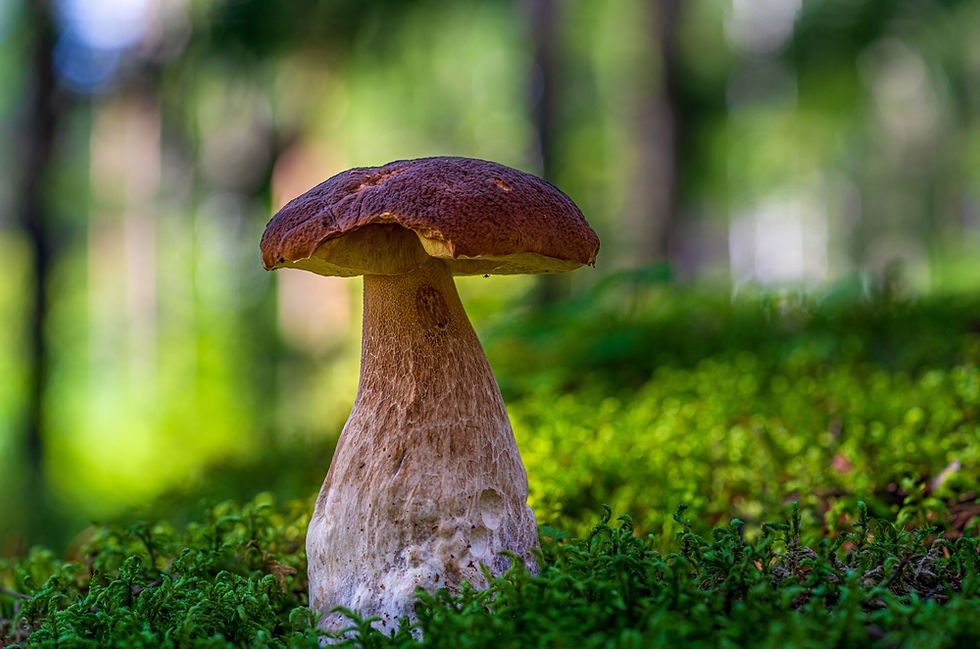
Some people cut them paper thin and eat them raw, but only try that with young clean mushrooms, and in small amounts in case you have any sensitivity.

Wild Porcini taste so much better than store bought Porcini, which are not only blander, but often different types of boletes with sneaky labelling.
If you do find Porcini, you might like to spread the love by making up a spore slurry to inoculate more trees, perhaps ones that are closer to you. Give it a go, especially if you find mushrooms too old to eat!

Mushroom enthusiast Paul Ward (known as “Speedy” to his friends) has had success inoculating Porcini in Central Victoria. Here's how he does it:
• Use mature Porcini, just the pores, or preferably whole overripe mushrooms. You may also add whole mature A. muscaria or A. rubescens in with the mix. • Blend with chlorine-free water to make a little mushroom smoothie. • Dilute into 10–15 L of chlorine-free water. Add liquid humate and 1 tbsp rock salt. • Aerate with a fish tank bubbler and air stone for 24 hours. • Choose pines or oaks with active root growth, ideally above 300 m elevation where multiple tree species grow together. • Prioritise sites already hosting Amanitas (often indicating lower pH soil).
• Walk to the edge of the tree's branches. Stop there, that's the root zone. The dirt right under the outer edge of the tree's branches is where the small feeding roots are waiting. Scratch a 1–2 cm deep line in the soil with a trowel.
• Slowly pour the slurry into the line so it soaks into the feeder roots.
• No need to bury or cover, just leave it.
• Repeat for several trees.

His patch took about 5 years before the Porcini popped up! He's done many more since then, and who knows, maybe the Porcini you discover might be thanks to Speedy!
There’s no hard and fast formula, and if you feel like going full mad scientist, you can experiment. Some people add a handful of soil from beneath the target tree to introduce microorganisms. Add some mashed potato and a splash of molasses for some extra carbohydrates. A small amount of coir peat can help mellow the stink. And a drop of liquid potassium soap or rinse aid (a surfactant) reduces surface tension, helping the spores disperse more evenly through the water.

Go forth into the forest on your Porcini pilgrimage! May the forest call when it's time to go searching. And if the Porcini don't find you, you'll find a basket of other goodies along the way. The forest rarely sends you home empty handed. Happy hunting, may you find the path less traveled.
¹Porcini usually refers to Boletus edulis, but it also includes other European species including B. reticulatus, B. pinophilus and B. aereus. The name Porcini can actually extend to any species that sits in the same close genetic lineage as B. edulis. DNA sequencing has confirmed B. edulis and B. pinophilus are present here in Australia. We also have a native species that belongs to this same Porcini lineage, Boletus austroedulis, which occurs in tropical QLD and NT.


Thanks Katherine for a great read. I am a regular porcini forager in Southern NZ and can confirm your view if the conditions are right they can be found any time of the year. I once almost did the full calendar (at least one find per month in a row) and got to 11, from September through July. I missed that August unfortunately, but others have found them then if there is milder winter. Having a range of locations, hosts and microclimates to check on certainly helps to keep getting a good feed. Thanks again for the blog.
Great article Katherine.
Lots of pointers in there to assist in foraging for porcini. Found my first porcini this season being new to mushrooms, have a few areas that look like prime spots. Can’t wait to get out there, happy hunting.