A Garden of Nasturtiums
Updated: Aug 16
In a garden of Nasturtiums it's always spring. In Melbourne, they can bloom all year round; an ever-present cascade of reds, yellows, and oranges.
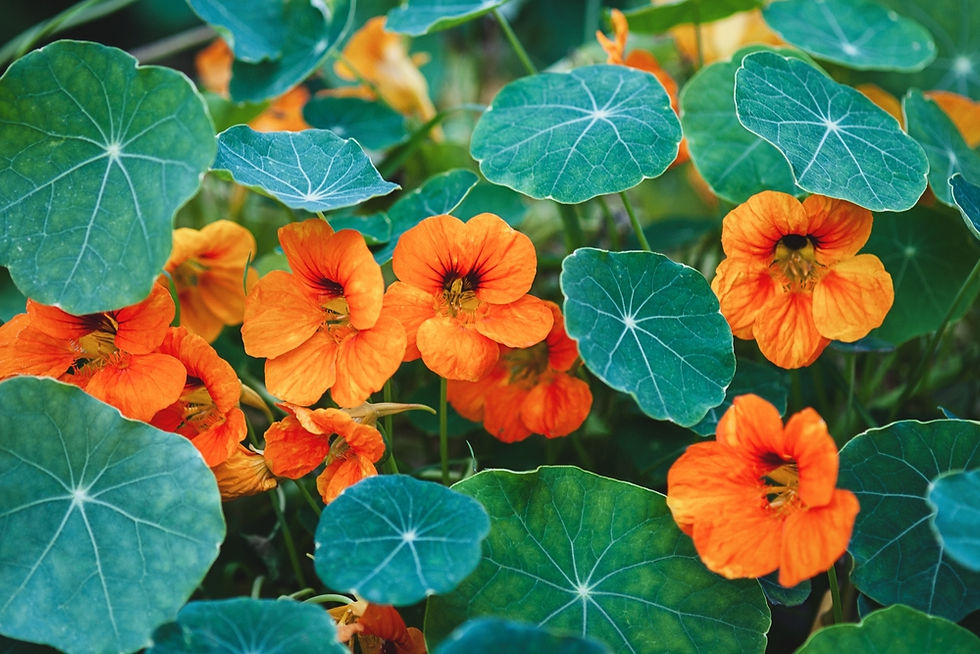
Their leaves look like rounded lily pads, worthy of being in a fairy tale. On a rainy day, you can imagine the garden bugs huddled underneath, using them like a tiny umbrella.

And of course they are delicious. Nasturtium leaves have a distinct wasabi-watercress flavour. The flowers have milder notes of sugar and pepper, and the seedpods are like crunchy bites of spicy radish.

Here's how to identify common Garden Nasturtium, Tropaeolum majus:

Leaves
• Almost round, with a shallow ripple around the edge • The leaf stalk joins the centre of the leaf (peltate), rather than the edge • Pale veins radiate outwards from the centre • Smooth • Bright green, sometimes blue–green • 3–15 cm across

Flowers:
• Usually red, orange or yellow
• Rarely pink, peach or purple
• Five petals, with the upper two slightly larger than the lower three
• The back of the flower extends into a long, hollow tube

Stem:
• Round, smooth and succulent
• Easily snapped with a crisp sound
• Usually trails over surrounding vegetation

Seeds:
• Green when fresh, yellow or tan when old
• Knobbly and wrinkled
• 1–2 cm across

Habitat:
• Found around gardens, community veggie patches, nature strips, parks, and Darebin and Merri Creeks.

Nasturtiums are native to South America where they evolved alongside hummingbirds. They have a pocket of super sweet nectar hidden at the base of their flowers. Their flowers are perfectly shaped for a slender beak and long tongue. While we often think of bees as the quintessential pollinators, bees actually tend to favour blue, purple and yellow flowers, and can’t see the colour red the way we do. A hummingbird's favourite colours are the fiery reds and oranges you see in Nasturtiums.
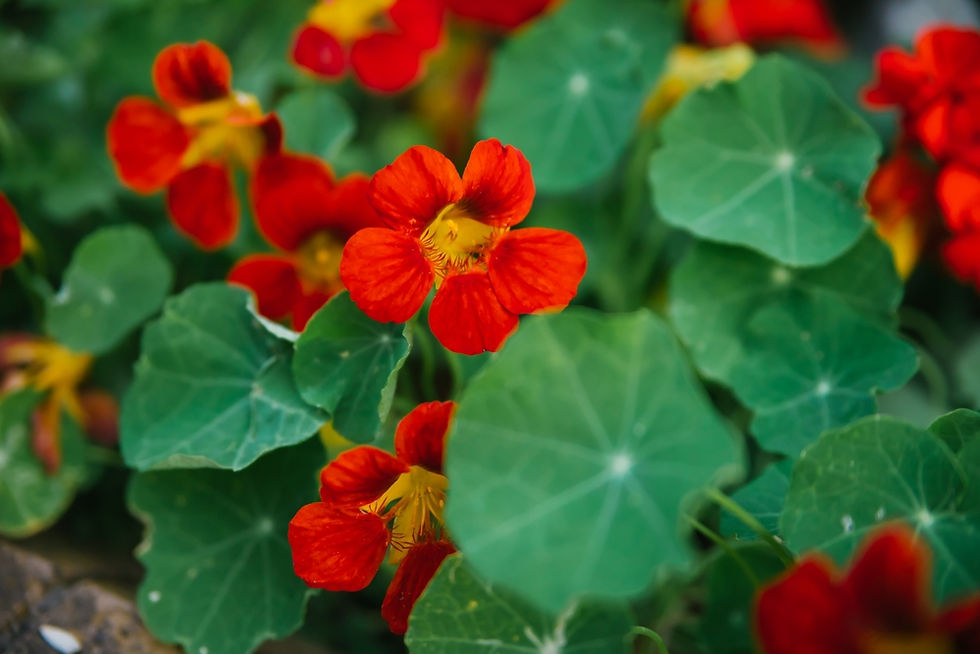
Here in Australia, honeyeaters and lorikeets sometimes try to drink the Nasturtium nectar, along with the garden bugs. Most can’t quite reach it, but that doesn’t stop them from trying. Rainbow lorikeets sometimes impatiently bite through the whole flower just to get to it! Bees and butterflies brush against the pollen as they clamber through the flowers. You’ll often notice bees disappearing headfirst into the blooms, only to back out awkwardly a moment later, before buzzing off to the next one.

Foragers can also have a go at tasting that sweet nectar. Take a tiny bite at the base of the flower, then try sucking it out. But my favourite way to serve the flowers is to collect a whole bunch and roll a log of goat cheese in the petals and dill. They can also be baked on top of focaccia, added to salads or ice cubes, or whipped up into jelly or cordial.

The leaves can be added to sushi bowls, rice paper rolls, charcuterie boards, salads, and sandwiches. Whizz them up into some chimichurri, creamy dip, or pesto style sauce. I think they work well as a substitute for horseradish, wasabi or watercress in any recipe. I've heard of them being used as a vine leaf substitute in dolmades, but I'm sure my Greek friends will tell me that's sacrilege!

The leaves are exceptionally nutritious, with four times more vitamin C than oranges. Their peppery flavour comes from compounds called glucosinolates, which break down into substances with antibacterial and antiseptic properties. In traditional herbal medicine, the leaves were crushed and applied directly to cuts and wounds to aid healing.

The crispy seed pods are also pretty amazing. You'll have to go hunting for them; they play hide and seek among the vines and can be hard to find. The pods look like little wrinkled knobs. Only pick the green ones, as they become bitter once they start to yellow.

The pods can be eaten raw or added to salads, or made into a caper substitute after being pickled or fermented. They're commonly called Poor Man's capers, but I prefer these wannabe capers to the regular ones! This is how I make them:

Povo Capers
• 250 ml chlorine-free water
• 12.5g additive-free sea salt
• At least a handful of seed pods
Make a 5% salt solution using sea salt and water. The easiest way to do this is to use a scale, but you can get out the measuring cups if you don't have one.

Add your seed pods to a sterilised jar, and weigh them down with a piece of baking paper and a fermentation weight (or improvise with a rock). The little knobs will keep trying to float but do your best to cover with the paper.

Leave them on the bench in the saline for a few days. If any escape the baking paper and float to the top, just give them a regular mix to make sure all sides stay in contact with the salt water. Then transfer them to the fridge, leave them for a few weeks, and they’re ready.

The liquid will go a little cloudy, but that’s totally fine. Eat them within a few months, although they don’t usually last that long!

They can have a bit of a funky stink, but I guess that’s lacto-fermentation for you. Probiotics usually smell questionable, but they’re good for you and yum! That said, if the smell knocks you over, something's gone wrong, so bin them.

I like to add these wannabe capers to salads, pizza, or bagels, and they’re especially good with smoked salmon.

You can also pickle them in vinegar, sugar and water, but they won't remain as crisp when using that method.
Anyway, that's my spiel. Next time you see Nasturtiums, give them a go!


Comments