A Little Green in Your Purse
Shepherd's Purse was on my foraging wish list for a while before I finally found it. I first heard about it when a friend was feeling homesick. She asked if I could track some down so she could cook some familiar Shanghai recipes. It grows across Asia and Europe, but it's especially enjoyed in parts of China, Korea and Japan.

After a long search with no luck, I finally stumbled across it close to home, and then it started appearing literally everywhere. How had I ever overlooked it? It's funny once you finally find something, you suddenly start seeing it everywhere.

It tastes similar to spinach, but with a distinctive aromatic quality, almost like some kind of spice. It's versatile and used in all sorts of delicious dishes, like dumplings, spring rolls, savoury pancakes, steamed buns, congee, soup, stir-fries, and heaps more! Yummo! You can eat the whole thing, root and all. The root is a good substitute for ginger, and the dried seed pods can be used kinda like pepper.

When Shepherd's Purse goes to seed, little heart-shaped pods line the stem, and they’re what give the plant its name. The binomial name, Capsella bursa-pastoris, translates as “little purse of the shepherd”.

But why a shepherd’s purse? Well, those heart-shaped seed pods kinda look like a pair of ram’s testicles. How fun. Historically, shepherds carried leather pouches, using up the otherwise wasted bits of leather, like... the balls.

If bollocks are a bit too crude for your liking, think of them as pretty little love hearts instead ♥♥ In China, it's known by some more polite names, like hùshengcao (护生草), which means 'life protecting herb'. I wish the English name was something sweet like that!
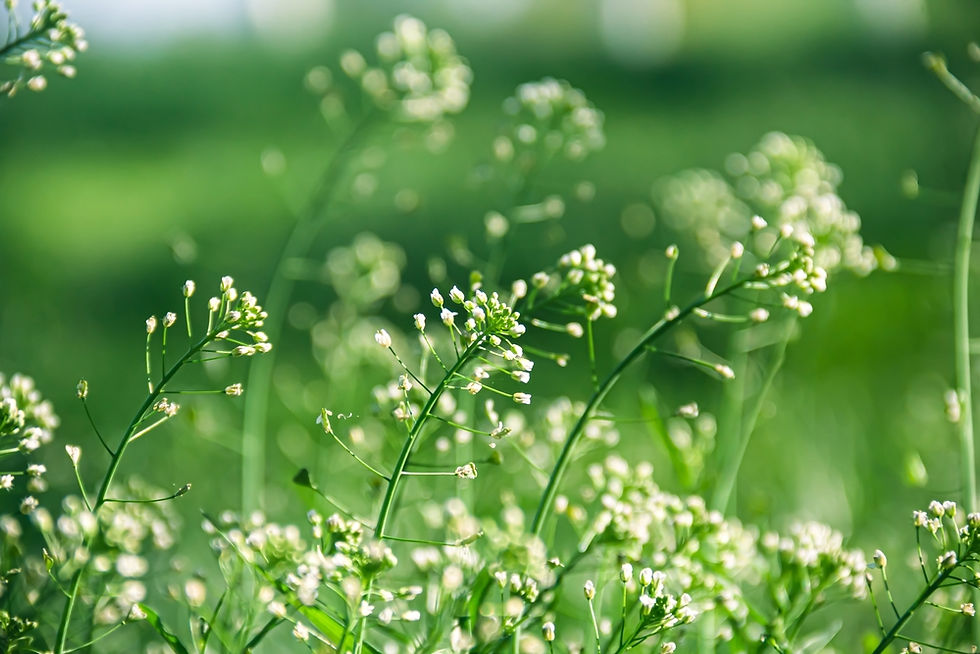
Shepherd's Purse changes its appearance as it grows, so it will look quite different depending on the age of the plant. Here's what to look for:

Leaves at the base (basal):
• When Shepherd's Purse is young, its leaves grow in a flat circle at ground level, spreading outwards from a central point
• This is called a basal rosette
• The basal leaves are often deeply lobed, with jagged edges
• Sometimes the basal leaves only have a serrated edge, instead of being deeply lobed
• The basal leaves grow from the plant's root, rather than along a stem • Young plants do not have a stem or flowers
• As the plant grows taller and develops a flowering stem, the lower leaves start to wither, and old plants do not have any basal leaves left at all

Leaves along the stem (cauline):
• As Shepherd's Purse matures and grows an upright stem, it develops a different type of leaf along the stem
• These stem leaves are called cauline leaves
• The cauline leaves are smaller and thinner than the basal leaves
• They're an elongated shape
• The base of each leaf clasps around the stem, like a hook (key identifier)
• Cauline leaves only develop once the plant grows a stem, so they're only found on more mature plants

Stem:
• Shepherd's Purse develops a 20–40 cm stem as it matures
• It's thin, flexible and firm
• Sometimes slightly hairy towards the base
• No sap when broken
• Mature plants often develop branching stems, with smaller stems growing out from the main one
• Heart-shaped seed pods develop along the flowering stalks (key identifier)
• Each seed pod sits on its own tiny stalk, sticking out from the main stem

Flowers:
• Little white flowers
• Shepherd's Purse belongs to the Brassica family, the same family as broccoli, mustard, and many other common vegetables
• Brassicas have a distinctive flower structure:
▸ 4 petals, arranged in a cross shape
▸ 4 sepals underneath the petals
▸ 6 stamens, with 4 long and 2 short
▸ 1 pistil in the centre of the flower

Location:
• Grassy areas in full sun
• Parks, nature strips, backyards
• I find it growing abundantly around Rosanna Parklands, Darebin Creek and Merri Creek

Season:
• In late winter, the basal rosette can be found
• In spring, you can find it with the seed pods

Lookalikes:
• When Shepherd's Purse is only at the basal rosette growth stage, it's harder to identify and may be confused with other plants that also grow in a rosette
• Capeweed, Arctotheca calendula, is a common toxic lookalike around Melbourne, with a basal rosette growth pattern and deeply lobed leaves • Capeweed has distinctive yellow daisy-like flowers, but could be confused before it blooms
• Capeweed's leaves are pale on the underside (key identifier)
• Capeweed never develops a long stem or heart-shaped seed pods like Shepherd's Purse • Dandelion, thistle and prickly letttuce are some other edible weeds that also grow in a basal rosette, but are easy to differentiate once they bloom
• Waiting until Shepherd's Purse starts flowering and developing seed pods makes identification much easier

Shepherd's Purse tastes better before it goes to seed, though it's trickier to identify when you're relying on the rosette leaves alone. I usually chop the whole thing up, seeds and all, and use it in dumplings.

My friend who introduced me to Shepherd's Purse gave me this dumpling recipe, but she didn't provide quantities: you're meant to measure with your Chinese eyeballs. Mine didn't come with that feature, so here's my best guess.

Blanche's Shepherd's Purse Dumplings
200 g Shepherd's Purse, or however much you can find 250 g minced pork
3 spring onions
A few garlic cloves, minced
Knob of ginger
2 tbsp Shaoxing wine
1 tbsp soy sauce
Pinch of salt, pepper and sugar
Dumpling wrappers
To serve:
Black vinegar
Chilli oil (with the crispy bits)
Don't eat pork? Use shiitake mushrooms, minced prawn or chicken instead, with some extra fat added to keep the filling juicy.

Finely mince the aromats and chop everything else, then mix well and add to the dumpling wrappers. Try to fold them into a beautiful shape by copying a YouTube tutorial. If you fail miserably like I do, fold them into half moons instead. Steam for 10 minutes or pan-fry.

I usually sub out the spring onions for a bunch of onion weed, Allium triquetrum, which is everywhere in spring. I'm always trying to find ways to use Peruvian pepper, Schinus molle, which is ridiculously common in Melbourne, so I sometimes add a tiny amount of that too.

This is a great recipe to serve to your non-foraging friends, who might be a little suspicious of your other foraged goodies. Who doesn't appreciate a good dumpling?! But don't eat this one if you're pregnant, as Shepherd's Purse can induce contractions.

Even though it's eaten more widely in Asia, Shepherd's Purse was actually intentionally brought to Australia by British colonisers in the 1800s for its medicinal purposes. It's especially good at stopping bleeding. It's been used for heavy periods, postpartum bleeding, nosebleeds and haemorrhoids. The European Medicines Agency actually has an official assessment for it as a treatment for heavy menstrual bleeding, taken a few days before your period.

I feel like I need to add a disclaimer: use herbs alongside conventional medicine, not instead of it. Get the best of both worlds. Shepherd's Purse is one piece of the puzzle, not a complete cure. Nothing is, really. Health is a big picture, and herbs can be a part of it.

Then there's also the doctrine of signatures, the old idea that a plant looks like whatever it fixes. Shepherd's Purse pods look like little purses, and a purse was interpreted as a pocket in the abdomen: the uterus, which is exactly where the plant was used to regulate bleeding. Those pods also look like hearts, so some modern herbalists read them as a signature for emotional heart work and prescribe it for sadness.

I like the thought that the world offers us plants for all sorts of conditions, some of them with signs to decode. However it got here, that feels like a gift, with hints left for us to discover.

I hope you get a chance to pick some this season! What started for me as a favour for a friend turned into a new addition to my foraging repertoire. Now I have another delicious weed to look for on my wanderings, another ingredient to experiment with, and another excuse to make dumplings.


Comments