Sprinkles of Twinkles: Borage
Updated: Jul 23
I just love flowers. I'll never pass by without stopping to enjoy them. Designed for pollinators, I wonder if bees also stop to appreciate their beauty? I like to think so. A moment of admiration as they hover above; deciding on the prettiest flower to settle on.

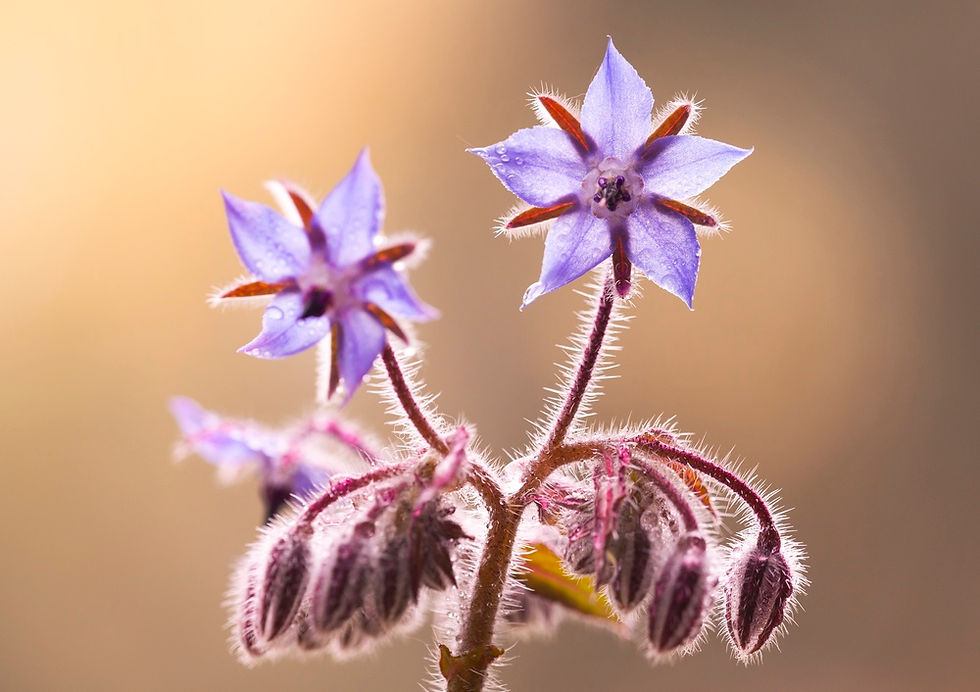
Borage, Borago officinalis, is spectacular. A herb of blue stars, twinkling as they sway in the breeze.

But Borage isn't just for admiring. It's also for eating.

It tastes like cucumber with a hint of shellfish. The leaves can be used in salads, stir-fries and sandwiches. The flowers can be used to adorn drinks and desserts; fit to grace the table for a faerie feast. If you collect enough flowers, you can make them into a blue → pink colour changing tea, which will wow your dinner party guests.

It's easy to identify with distinctive looking flowers. Here are the features to look out for:

Flowers
• Usually vivid blue, sometimes pink, and some rarer varieties are white
• Star shaped flowers with five pointed petals
• Prominent black/ dark purple anthers in the centre
• Flowers hang downward on curved stems

Stem
• Covered in fuzzy hairs
• She thicc [thick stems]
• Tips are often a red/purple colour
• Often branched
• Up to 1 metre tall

Leaves
• Softer, finer hairs
• Crumpled and floppy looking
• Large, lance-shaped
• Alternately arranged
• Smell like cucumber

Lookalikes:
• Forget-me-nots are sometimes confused, which have rounded petals

When & Where
• I've found it in bloom in all months except August, but typically spring to autumn
• Common around gardens.

They have a slight prickle when you harvest them, but not enough to bother with gloves. The hairy bristles along the stem are there to encourage bugs to eat the leaves instead of chewing through the plant's main support.

I keep spotting them around community veggie patches, and sometimes they've gone and self-seeded themselves right onto the nature strip. They're planted to attract pollinators and to lure hungry caterpillars away from eating the primary crops. Borage doesn't need much fussing over, so it occasionally grows wild as well.

Whenever I find some, I munch on a flower or two as a little pick me up. They’ve got a reputation for making you feel good; sparking courage, happiness, and contentment. People have been harvesting borage for millennia for these effects. It's full of minerals that help settle your nervous system.
Medieval herbalists thought it could cure melancholy blues, and would float borage flowers in wine. It's so pretty, just looking at it might cheer you up! Pliny the Elder even called it euphrosynum, meaning "plant that cheers". Borage flowers were traditionally added to baths to help relax before a stressful event.

Ancient Roman soldiers were rumoured to scull borage wine before heading into battle, hoping it would grant a little extra bravery during the fight. This custom seemed to have persisted into the Middle Ages, with departing Crusader knights offered a parting drink with borage flowers before they left for battle.

It was also used in European folk magic. I imagine Luna Lovegood would have a go at making this traditional charm:

Courage sachet
Ingredients:
• Borage leaves and stems
• Rosemary (go for a walk around the block, you'll find some)
• Bay leaves (remarkably easy to forage, I find them near Darebin Creek, but they're often growing over the fence in people's front yards)
Tie up the herbs with a ribbon or twine, then hang upside down for a few weeks until dried. Keep in a little organza bag. Leave beside your pillow, keep in your pocket, or scatter in the wind.
Accompany with a little rhyme:
Heart be lighter, spirit rise,
Clear the clouds before my eyes.
Courage bloom where fear has been,
Joy return and grow within.


Comments