What a Prick: Stinging Nettle
Any plant with 'stinging' in its name sounds like a menace. Stinging nettles are so damn delicious that, faced with constant threat of being eaten, they evolved little hairy hypodermic needles to deter you.

I gotta give nettles some kudos. They're badasses, with a reputation for violence. They know what they want, and they don't want to be eaten.

Don't let this frighten you. Their bark is worse than their bite—while yes, they prickle, they're nowhere near as bad as all the other pricks out there. You can easily avoid the sting with a glove or turned out paper shopping bag. If you're a masochist, pick them barehanded, just see what happens.

I have chronic pain, so it makes me think I’m tough enough to be unfazed by a little sting. The first time I picked them barehanded, I sussed out the severity of the sting with a few gentle upward strokes. Nothing happened, giving me a false sense of security. Like many times before, I hadn't accounted for a delayed onset of effects, so I took some more. A few minutes later, it hits; the feeling of freezer burn, sharp and startling! Manageable though. It came good 10 minutes later, after soaking my hands in warm water with a bit of dishwashing liquid.
I can't be bothered bringing a pair of gloves when I go for a stroll around the block. The next time I improvised with a fig leaf to grasp my nettle haul. But I definitely recommend wearing gloves.

So how do they sting? They don't have thorns, but urticating hairs, which are very fine hairs with a bulb at the base filled with a cocktail of ouchies: Histamine, Acetylcholine, a couple of types of acid, and Serotonin. While Serotonin makes your brain happy, it can't cross the blood-brain barrier, so don't try self-medicating your crippling social anxiety.

The nettle's sting is often blamed on formic acid, the same stuff in bug venom. This sounds scientific enough to survive unchecked, but it's a foraging myth.

Because they are fine hairs, not thorns, they are easily destroyed. Cooking, freezing, blending or drying will all destroy the prickles so they're safe to eat. Heat will also denature the chemicals, but they're still fine to eat raw if blended or juiced. They are absolutely yum and well worth it!

So how do we identify stinging nettle (Urtica spp.)?
Leaves
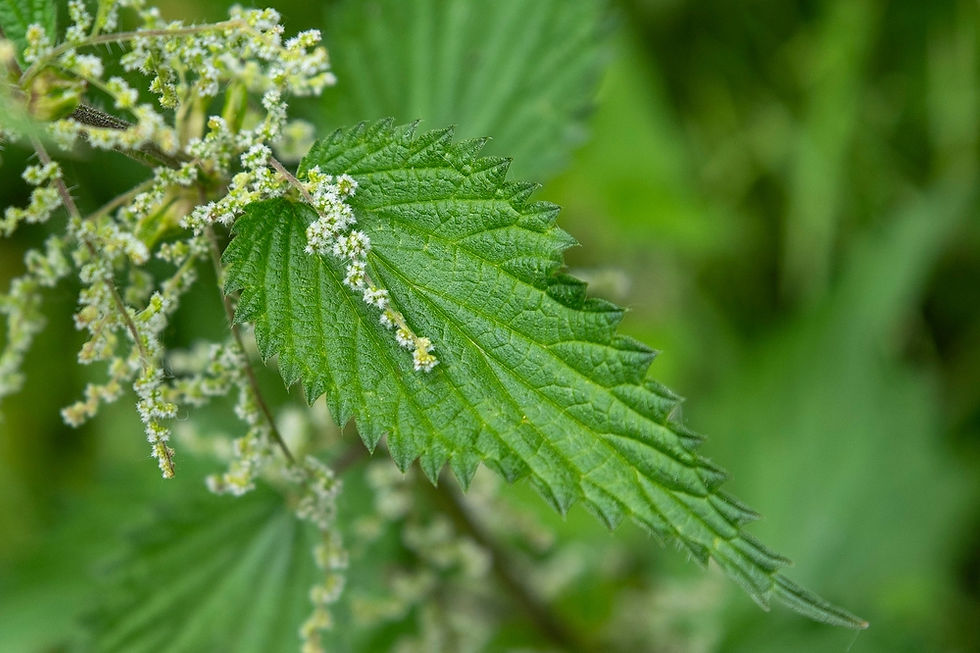
• Shape: Heart, tear, or triangular shape with a pointed tip
• Edge: Sharply serrated, not rounded
• Colour: Medium to dark green
• Texture: Pronounced veins giving a crinkled appearance, thin and flexible
• Size: Typically 3 – 12cm

Arrangement
• Opposite pairs of leaves, growing directly opposite each other on the stem
• Square formation: When viewed from above, the opposite pairs create a distinctive square or cross shaped arrangement

Stem
• Shape: Square stem, noticable if you cut a cross-section
• Surface: Covered in fine hairs, and noticeable vertical grooves running along its length

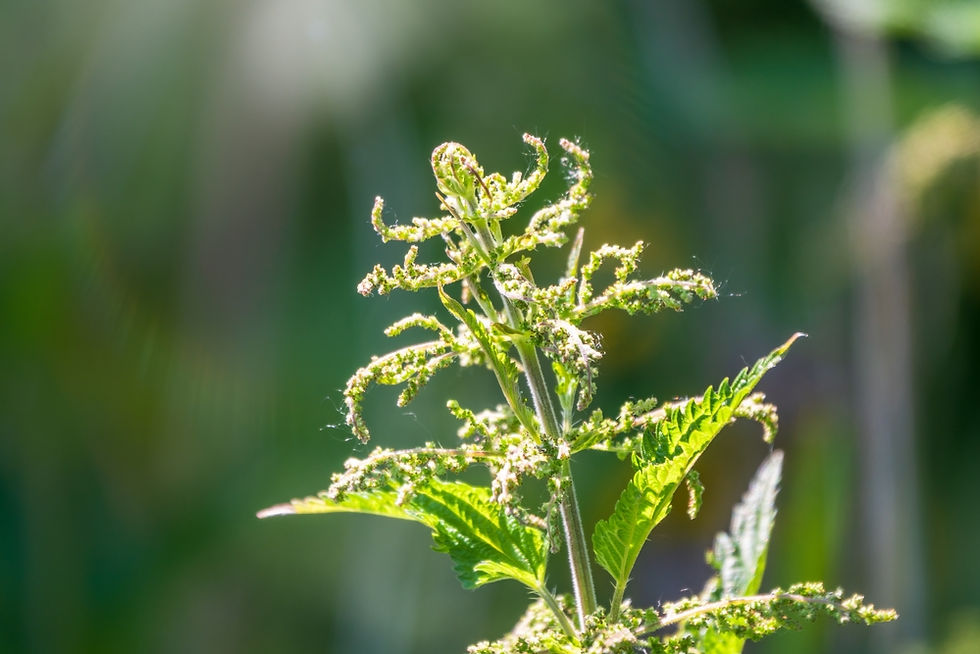
Flowers and seeds, if in bloom
• Colour: Greenish or whitish
• Growth pattern: Tiny drooping pearls; long, dangling clusters
Season
• Spring and Summer: Thrive after a wet spring, leaves eaten when young, seeds harvested in summer
Environment
• European stinging nettle (Urtica dioica): All around the world; here, there and everywhere, but prefers areas near water
• Native Australian scrub nettle (Urtica incisa): Especially Eastern and Southern Australia, rainforests and creek banks.

The scrub nettle is harder to find, and has darker, longer and thinner leaves. It was traditionally used by Aboriginal people for food, medicine and weaving.
Stinging nettles are fairly easy to identify, but if unsure, touch it— I dare you. Some people are much more sensitive to the sting, so don't come crying to me afterwards.

Slip on some rubber gloves and try picking in an 'upwards' motion, as that's the direction of the little hairs, reducing the risk of the hairs breaking off. If you snip with scissors, even better.
Aim to harvest the young tops or dense leaves. Nettles have separate male and female plants. The males produce flowers, while the females grow the edible, nutritious seeds, which are worth harvesting later in the season. But the moment you see flowers or seeds growing, stop picking the leaves; the foliage starts producing calcium carbonate rods that aren't friends with your kidneys. Leave those older leaves for the caterpillars; it's their favourite.

Got stung? A bit of dock stem will be a remedy; there's probably some nearby. Younger dock stems have a sticky gel-like liquid at their base, or stems can be broken to get more. Use it like lotion to reduce the sting. If you can't find dock, smooshed plantain leaves are second best.

The main nettle lookalikes you might come across are mint and catnip, and both are edible. The easiest way to tell is to gently crush a leaf—if you smell a minty scent, it's mint or catnip. Mint has smoother leaf edges and a stronger smell, and catnip has slightly rounded, scalloped edges. You might carefully risk caressing the stem: a smooth stem belongs to mint, soft hairs are catnip.

Nettles are one of the most nutrient dense vegetables on the planet. They contain the highest forms of plant-based protein, calcium, iron, zinc, magnesium, copper, selenium, potassium, manganese, and vitamins A and C. Young nettles have more iron than beef. They have fibre, antioxidants, beta-carotene.

They are completely superior to boring supermarket greens. Ditch the bland lettuce that tastes like water. Food is meant to be tasted. If you don’t like the flavour of wild greens, bless your beige heart. Your tastebuds are as daring as a loaf of white bread, but they're ready for an upgrade. Eating wild is the OG menu and you'll acquire a palate for it. Nettles aren't as bitter as other wild greens, so are a good starting point.

Lettuce wilts, spinach gets slimy, and supermarket greens are prewashed, barcoded, and sealed in plastic. Why bother letting them die in your fridge when you can step out to your backyard or the nature strip and get something fresh whenever you want?

Nettle taste bright, earthy and green. They taste similar to spinach and cucumber, with a mild, grassy, peppery flavour. Common stinging nettle has a faint seawater note, while scrub nettle lacks the saltiness.

Stinging nettle deserves their own entire cookbook [note to self: recruit my chef friends]. Make into pesto, pasta dough, curries (nettle paneer, anyone?), stir-fries, soup, crepes, frittata, scrambled eggs, corn fritters, focaccia, bright green sponge cake (my favourite), smoothies, beer, cordial, tea (tea tastes like trash but it's healthy). Grind some dried seeds into flour for baking. Weave the dried stems into a little craft project. If you keep chickens, offer them the fresh greens; they turn their yolks a vibrant gold. The stinging mechanism is designed for mammalian skin so your chickies will be fine. Some of these dishes require a quick blanch before adding, but I'm sure you'll figure it out.

Nettles have been foraged and revered by cultures across millennia. Aboriginal peoples roasted them between stones for food and even used the sting itself to soothe joint and muscle pain. They appeared in Bronze Age stews, wrapped Egyptian mummies, and were brewed into Native American tonics for strength. In ancient Greece, Hippocrates catalogued over 60 nettle remedies, while Medieval Europeans turned them into hair rinses and healing tonics. Modern herbalism uses nettle to treat hay fever, which is ironic, given they can also cause it, creating a problem just to sell the solution. How very rude.

The Romans famously practiced urtication: self-inflicted lashing with nettles after a hot bath. They were so committed to the ritual that they even imported a specific species, Urtica pilulifera, for the job. This masochistic therapy was believed to cause a circulation rush and temporarily relieve the aches of rheumatoid arthritis, which they blamed on the cold climate.

I was oddly enthusiastic about trying nettle sting therapy firsthand; part scientific curiosity, part desperation for pain relief. But my neighbours beat me to the last of the nature strip nettle, so the experiment was postponed. My brush with this extreme folk remedy will have to wait.

Stinging nettles are misunderstood in our modern world, so I hope you're brave enough to pick some. While usually in season in spring, I noticed some fresh ones a week or two ago, perhaps encouraged by Melbourne's unseasonable heavy rains. Check the creeks in your area, and if you can't get some fresh leaves, you should be able to find some seeds.
If you're reluctant, good. The nettles like that!


Comments