Respect Your Elderflowers
Elderflowers whisk me away to an English summer. Elder trees humming with bees, blooming with little fluffy clouds, haunted by faerie folk. In Germanic folklore, guardian spirits dwelled in these trees, so when you gather their blossoms, you might be taking home something enchanted.

Danish legend tells of a mystical sight on Midsummer’s Eve, a night where the veil between worlds wears thin. Stand beneath an elder tree, and you might see Elverkongen, the King of Fairyland, ride by with his entire entourage. But be careful, they were dangerous and could lure people to their death by dancing!

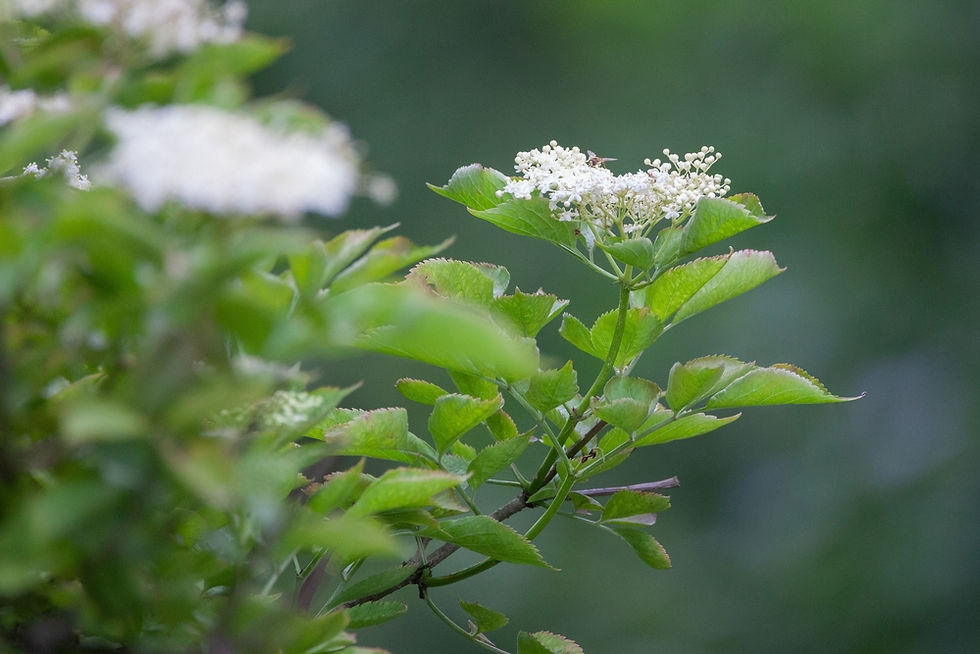
So how do you find one of these enchanted trees? Here's how to identify elder (Sambucus):
Leaves:
• Each leaf is made up of 5-7 serrated leaflets
• Each leaflet has a central vein and side veins
• Leaflets are arranged in opposite pairs with a single leaflet at the tip
• In winter, new buds are purplish

Flowers:
• Large clusters of tiny, creamy white flowers
• Each tiny flower has 5 rounded petals and yellow anthers
• Lychee-rose-honey scent
• In bloom during late spring and summer
• Some varieties have pink flowers (less common)

Berries: • Small and glossy
• Heavy, umbrella shaped clusters
• They ripen from green into a deep purple-black
• Some varieties ripen to red (rare around Melbourne)
• Ripe berries are held on by short reddish coloured stalks
• They fruit from late summer into autumn
• A few small, pale seeds

Tree:
• Small tree or shrub
• Multiple twisted wood trunks
• Brittle branches

Habitat:
• Likes damp soil, found wild near waterways, or planted in parks and gardens.

While elder is regarded as a beginner friendly forageable goodie, please carefully read the warning below.
Deadly toxic lookalike – Poison Hemlock

Poison Hemlock is extremely toxic and could be mistaken for elderflower by inexperienced foragers. Ingesting it is often fatal, and skin contact may cause severe poisoning. We will learn how to identify it now.

Hemlock and elder do look distinctly different, but because they both have white flower clusters, and symmetrical leaves, comparison is important.

Side-by-Side: Elder vs Poison Hemlock
Elder | Poison Hemlock |
Plant type and stem: Small tree or shrub. Woody, brittle stem with no blotches. | Plant type and stem: Tall plant (not a tree). Purple blotches on mature stems = key identifier. Young plants lack blotches. |
Leaves: Leaflets with a clear central vein and visible side veins. | Leaves: Fern-like leaves, repeatedly divided into fine segments; veins not obvious. |
Flowers: White flowers, yellow anthers in the centre. Tiny rounded petals. Flower clusters are 10-30 cm. | Flowers: White flowers, no yellow. Tiny petals are heart-shaped with a slight notch. Flower clusters are 7-15 cm. |
Smell: Typically floral, urine-like when old. | Smell: Musty, mousy, or urine-like. |


I include these warnings not to frighten or discourage you, but to equip you. Distinguishing between similar looking plants is a skill that can be learned by observing its defining characteristics.
So let's find some elderflower! I get mine from a few different parks in Melbourne, but you can also get it creeping over neighbourhood fences. If you're visiting the Ballarat area, there's heaps at the moment.

Elderflower is in season in November and December. Harvest them on a sunny morning before 10am, their taste will diminish later in the day. You'll need to prep them quickly, as elderflowers deteriorate and stink like kitty litter within a few hours.

Before you harvest, folklore tradition is to honour the tree spirits and ask permission to gather. Thankfulness is always a good practice in foraging! I also find respecting the old lore is a bit of ritual fun.

Choose fresh flowers heavy with pollen and sweet fragrance. Avoid any flowers that are starting to brown or smell bland.

Use scissors to cut the stems. Don't accidentally break a branch, you'll anger the elder tree spirit Hyldemor, and she'll send you bad luck as payback! Even worse is to bring a branch indoors, as menacing elves will come to haunt your home. Burned elder wood releases witches' souls, but although this warning may sound like some old world superstition, the threat is real: elder wood releases cyanide gas when burned.

Collect your flower clusters, give them a gentle shake to free any bugs, and place in a basket to let any remaining stowaways disembark. Avoid plastic to prevent wilting. Take only what you need; ten heads is enough for cordial. Leave the rest to feed the bees. You can collect some more after they develop into elderberries.

Elderflower has a distinctive tropical floral flavour, and can be used to flavour cordial, jam, desserts, wine, and liqueur. Do not wash them; you'll lose the flavourful pollen and yeasts.
Elderflower pairs nicely with gooseberry, strawberry or rhubarb in desserts. Use it to flavour cake fillings, jellies, posset, or trifle. You can add it to drinks with lemon, lime, mint, cucumber, gin or champagne.

In autumn, it becomes elderberry season! Cut the elderberries with the same care and thankfulness. Lady of the tree, I ask to share your berries for my cordial. Elderberries are ripe when purple-black or navy blue.

Elderberries taste bland on their own, but when cooked with lemon and sugar, they transform into a beautiful rich wine-berry flavour. Cook them for at least 15 minutes, and use them to make syrups, jams, mulled mulberry, or bake into pies and crumbles. Baking spices like cinnamon or ginger complement them, and they also pair nicely with apples.

A word of warning:
You must not eat elderflowers or elderberries straight from the tree. They contain glycosides or digestive irritants, which are neutralised by cooking or fermenting.

The stems, leaves, unripe berries, and bark all contain cyanide precursors. So unless you're a cult leader brewing cyanide laced Kool-Aid, carefully remove all stems from your flowers or berries.

Elderflower cordial: 10 elderflower clusters (stems carefully removed)
1 large lemon (zest + juice)
1 cup caster sugar
2 cups boiling water
1 tbsp citric acid (optional, improves shelf life)
Infuse: Place elderflowers (do not wash) and lemon zest in a pot. Add 1½ cups boiling water and citric acid (if using). Bring to a rolling boil, then turn off the heat. Cover and let cool completely.
Syrup: A few hours later, microwave remaining ½ cup water with sugar for 2 minutes until dissolved (careful, it’s hot). Wait a couple of minutes to slightly cool. Stir in lemon juice.
Combine and strain: Pour sugar syrup mix into the elderflower pot and stir well. Strain through a fine sieve into a sterilised bottle. Keeps for three weeks in the fridge, or a couple of months if using citric acid.

I hope this inspires you to find some elderflower! If you're courageous this Midsummer’s Eve, get in touch with your childhood sense of wonder, and dance around the elder. If you're lucky, you might be met with a “good evening” from the passing elves.


Comments